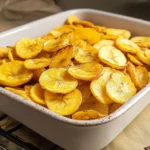
Ingredients
- Plantains: The star of the show! Plantains are starchy fruits that look similar to bananas but are less sweet and need to be cooked before eating. For baked plantain chips, the ripeness of your plantains is key. You’ll want to use slightly ripe plantains. What does “slightly ripe” mean? Look for plantains that are mostly yellow with some black spots starting to appear. If they are completely green, they will be too starchy and won’t have that subtle sweetness we’re aiming for. If they are overly ripe (mostly black), they will be too soft and sweet and might caramelize too quickly in the oven, potentially burning before they crisp up. Slightly ripe plantains strike the perfect balance – they are firm enough to slice thinly and evenly, yet have developed enough natural sugars to caramelize beautifully in the oven, yielding a delightful sweetness that complements the savory saltiness. You’ll need about 2-3 medium-sized plantains for this recipe, which will yield a generous batch of chips. When selecting plantains at the grocery store, choose ones that are firm to the touch and free from bruises or blemishes. Organic plantains are always a great option if available, ensuring you’re using the best quality fruit as the base for your healthy snack.
- Olive Oil (or Avocado Oil): Oil is essential for achieving that desirable crispiness in baked plantain chips. It helps to conduct heat evenly and prevents the plantain slices from drying out and becoming brittle. Olive oil is a fantastic choice due to its healthy monounsaturated fats and mild flavor. Extra virgin olive oil is preferred for its richer flavor and higher antioxidant content, but regular olive oil will also work well. Another excellent option is avocado oil. Avocado oil has a higher smoke point than olive oil, which means it can withstand higher oven temperatures without breaking down or smoking, making it ideal for baking at slightly higher temperatures if you prefer a faster cooking time. Avocado oil also has a very neutral flavor, allowing the natural taste of the plantains to shine through. You’ll need about 2-3 tablespoons of oil for this recipe. The amount might slightly vary depending on the size of your plantains and how thinly you slice them. The goal is to lightly coat each slice, ensuring they bake evenly and develop that satisfying crunch.
- Salt: Salt is the simple yet crucial seasoning that enhances the natural sweetness of the plantains and balances the overall flavor profile of the chips. Sea salt or kosher salt are excellent choices for their pure flavor and coarser texture, which helps them adhere nicely to the plantain slices. Table salt can also be used, but you might want to use a bit less as it tends to be more intensely salty. Start with about ½ teaspoon of salt and adjust to your taste. You can always add more salt after baking if needed. Don’t underestimate the power of salt – it truly elevates the taste of these chips from good to irresistible!
Optional Flavor Enhancements:
While the basic recipe of plantains, oil, and salt is delicious on its own, you can easily customize your baked plantain chips with additional spices and seasonings to create different flavor profiles. Here are a few ideas to inspire you:
- Cinnamon: For a touch of warm sweetness, sprinkle a pinch of cinnamon over the plantain slices along with the salt before baking. Cinnamon pairs beautifully with the natural sweetness of plantains and adds a comforting, aromatic dimension to the chips. This variation is particularly delightful for a slightly sweeter snack or even as a dessert-inspired treat.
- Chili Powder: If you crave a little heat, add a pinch of chili powder for a subtle kick. Chili powder provides a warm, slightly smoky flavor that complements the sweetness of the plantains and the saltiness. Start with a small amount and add more to taste if you prefer a spicier chip.
- Garlic Powder: For a savory and slightly pungent flavor, garlic powder is an excellent addition. Garlic powder adds depth and complexity to the chips, making them even more addictive. It’s a great option if you prefer a more savory snack over a sweet one.
- Onion Powder: Similar to garlic powder, onion powder adds a savory and slightly sweet oniony flavor that enhances the overall taste of the chips. It’s another fantastic option for those who enjoy savory snacks.
- Paprika (Smoked or Sweet): Paprika, especially smoked paprika, can add a wonderful smoky and slightly sweet flavor to the chips. Sweet paprika offers a milder, sweeter flavor and vibrant color. Both varieties add depth and complexity and are a great way to experiment with different flavor profiles.
- Black Pepper: A simple sprinkle of freshly ground black pepper adds a subtle warmth and spice that complements both sweet and savory flavors. It’s a classic seasoning that enhances the overall taste of the chips.
- Cayenne Pepper: For a significant kick of heat, a pinch of cayenne pepper will do the trick. Cayenne pepper adds a fiery heat that is perfect for those who love spicy snacks. Use it sparingly at first and add more to taste.
Instructions
Step 1: Preheat Your Oven and Prepare Baking Sheets
- Preheat your oven to 350°F (175°C). This temperature is ideal for baking plantain chips. It’s high enough to crisp them up nicely but not so high that they burn before they are cooked through. Make sure your oven is properly preheated before you put the plantain slices in, as this helps ensure even cooking and crisping. Using an oven thermometer is a great way to ensure your oven is accurately reaching the desired temperature.
- Line two large baking sheets with parchment paper. Parchment paper is your best friend when baking plantain chips. It prevents the chips from sticking to the baking sheet, making them easy to remove and clean up afterwards. It also helps to promote even browning. If you don’t have parchment paper, you can lightly grease the baking sheets with oil, but parchment paper is highly recommended for the best results. Using two baking sheets will allow you to spread the plantain slices in a single layer, which is crucial for even baking and crisping. Overcrowding the baking sheet will cause the plantain slices to steam instead of bake, resulting in soggy chips.
Step 2: Prepare the Plantains
- Peel the plantains. Plantain peels can be a bit tougher to remove than banana peels. The easiest way to peel a plantain is to first cut off both ends. Then, make a shallow slit lengthwise down the skin of the plantain. Use your fingers or the tip of a knife to carefully peel back the skin. It might take a little practice, but once you get the hang of it, it becomes quite easy. Make sure to remove all the peel.
- Slice the plantains thinly. This is perhaps the most important step for achieving crispy plantain chips. Thinly sliced plantains will cook through and crisp up beautifully in the oven. Thick slices are more likely to remain soft in the center. Aim for slices that are about ⅛ inch thick or even slightly thinner if you can manage it. A mandoline slicer is an excellent tool for achieving uniform, thin slices quickly and easily. If you don’t have a mandoline, a sharp knife will work just fine. Slice the plantains crosswise or diagonally, depending on your preference. Diagonal slices can be slightly larger and visually appealing. Try to keep the slices as uniform in thickness as possible for even cooking.
Step 3: Season and Toss the Plantain Slices
- Place the plantain slices in a large bowl. Using a large bowl gives you ample space to toss the slices without overcrowding and ensures even coating with oil and seasonings.
- Drizzle with olive oil (or avocado oil). Pour the olive oil (or avocado oil) over the plantain slices. Start with about 2 tablespoons and add more if needed to lightly coat all the slices. You don’t want the slices to be swimming in oil, just lightly coated.
- Sprinkle with salt (and any optional seasonings). Sprinkle the salt (and any optional seasonings like cinnamon, chili powder, garlic powder, etc.) evenly over the plantain slices. Start with ½ teaspoon of salt and adjust to your taste. If you are using additional spices, use them sparingly at first and add more to taste in your next batch.
- Toss to coat evenly. Use your hands or a spatula to gently toss the plantain slices until they are evenly coated with the oil and seasonings. Make sure every slice is lightly coated to ensure even baking and flavor.
Step 4: Arrange Plantain Slices on Baking Sheets
- Arrange the plantain slices in a single layer on the prepared baking sheets. This is crucial for crispiness. Make sure the slices are not overlapping, as overlapping will prevent them from crisping up properly. If necessary, use two baking sheets to ensure you have enough space to arrange all the slices in a single layer. Spacing them out slightly allows for better air circulation and even baking.
Step 5: Bake the Plantain Chips
- Bake for 15-20 minutes. Place the baking sheets in the preheated oven and bake for 15-20 minutes, or until the plantain chips are golden brown and crispy. The baking time can vary slightly depending on your oven and the thickness of your plantain slices. Keep an eye on them, especially towards the end of the baking time, to prevent them from burning.
- Flip the chips halfway through baking (optional but recommended). Flipping the chips halfway through baking helps to ensure even browning and crisping on both sides. Using a spatula, carefully flip each plantain slice. This step is optional, but it can contribute to a more uniformly crispy chip.
- Watch carefully towards the end to prevent burning. Plantain chips can go from golden brown to burnt quite quickly, so it’s important to watch them carefully during the last few minutes of baking. If you notice any chips browning too quickly, you can remove them from the oven while the rest continue to bake.
Step 6: Cool and Crisp Up
- Remove from the oven and let cool on the baking sheets. Once the plantain chips are golden brown and crispy, remove the baking sheets from the oven. Let the chips cool on the baking sheets for a few minutes. They will continue to crisp up as they cool. Resist the urge to move them immediately, as they are more delicate when hot.
- Transfer to a wire rack to cool completely (optional but recommended). For maximum crispiness, transfer the baked plantain chips to a wire rack to cool completely. This allows air to circulate around the chips, preventing them from becoming soggy on the bottom. If you don’t have a wire rack, you can simply let them cool on the parchment paper-lined baking sheets.
Step 7: Enjoy!
- Once completely cooled, the baked plantain chips are ready to enjoy! They are best enjoyed fresh for maximum crispiness. Store any leftover chips in an airtight container at room temperature to maintain their crispness for as long as possible. However, they are so delicious, leftovers are rarely a problem in our house!
Nutrition
- Serving Size: one normal portion
- Calories: 120-150
- Sugar: 4-6 grams
- Sodium: 50-100 mg
- Fat: 6-8 grams
- Saturated Fat: 1 gram
- Carbohydrates: 18-20 grams
- Fiber: 2-3 grams
- Protein: 1-2 grams